It was a privilege to contribute to the Underground Banking Roundtable hosted by fedpol / MROS Switzerland and brought together FIUs and law-enforcement agencies (LEA).
Rather than discussing Hawala in theory, my presentation focused on three practical questions and why understanding the modus operandi (MO) is crucial:
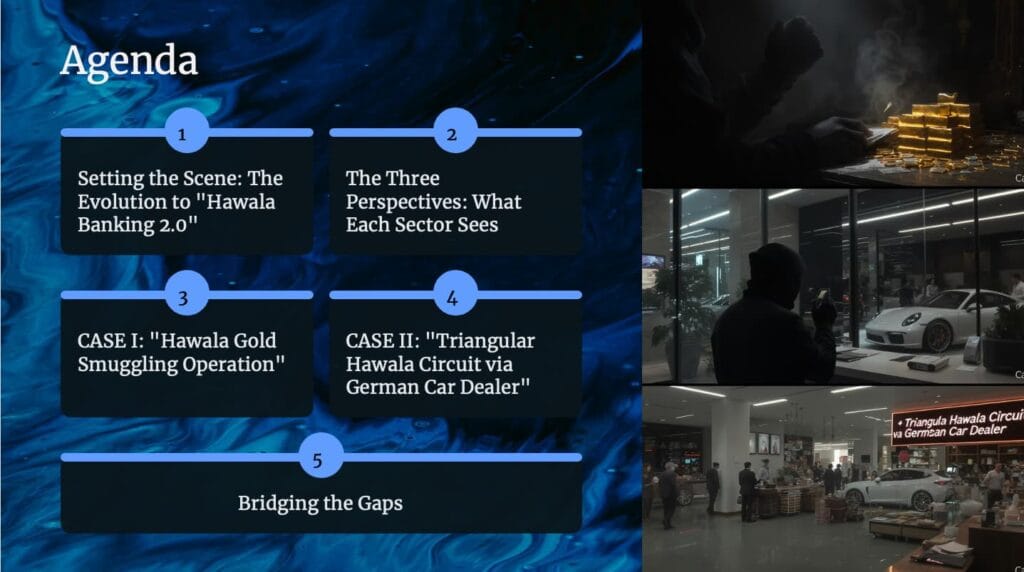
1. What exactly is the modus operandi?
2. What can obliged entities realistically see?
3. What evidence is needed to prove the case?
1. From indicators to evidence: what must LEA see?
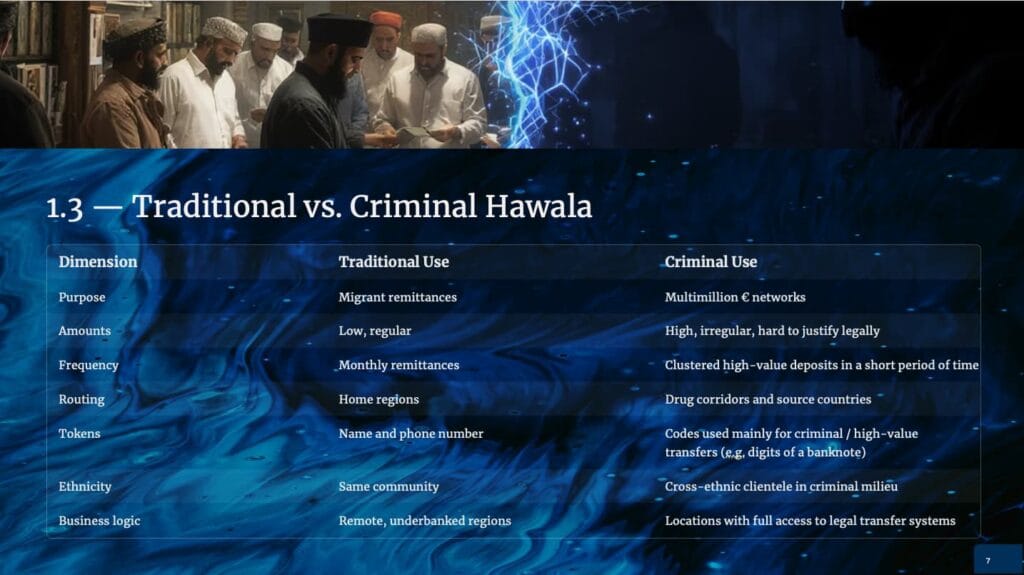
For LEA, the challenge lies not in recognising red flags, but in proving an underground banking system in court.
This requires moving beyond transactions to evidence of coordination and value transfer:
- Identification of brokers / coordinators, not only front companies
- Communication evidence (devices, chats, lists, codes) showing settlement logic
- Trade / logistics data (VINs, customs records, refinery links) proving that goods are used as value carriers
- Clear separation between payer, nominal buyer and true end-user
Only when financial data, communications and trade evidence converge does Hawala become legally provable.
2. What the bank actually saw and what it could not see
In one case, the bank did not see cash couriers or brokers. It saw:
- a company with employees and recurring expenses, but no genuine operating income,
- third-party payments from foreign corporates with no link to the stated buyer,
- a business model that almost covered its costs, but never generated real profit and
- high-velocity account activity inconsistent with the declared purpose.
The only visible signal was an economically illogical business — a classic cost-shell pattern.
3. How to prove Hawala in this pattern
The investigation focused on structure, not labels:
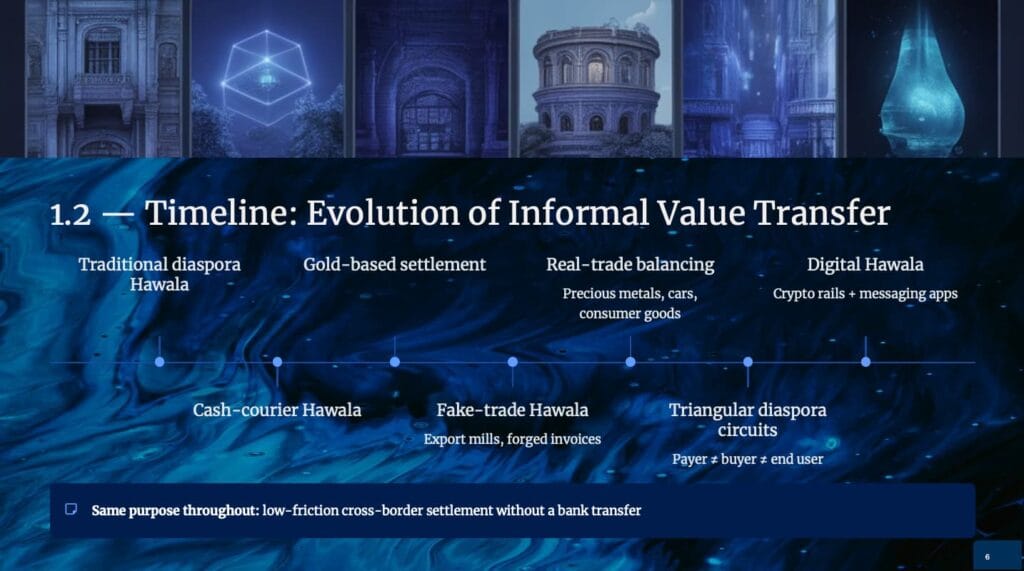
- Mapping the payer–buyer–user triad across jurisdictions
- Demonstrating that trade documentation did not explain value creation
- Showing that settlements occurred off-ledger, compensated elsewhere in the network
- Linking repeated patterns across cases, not isolated transactions
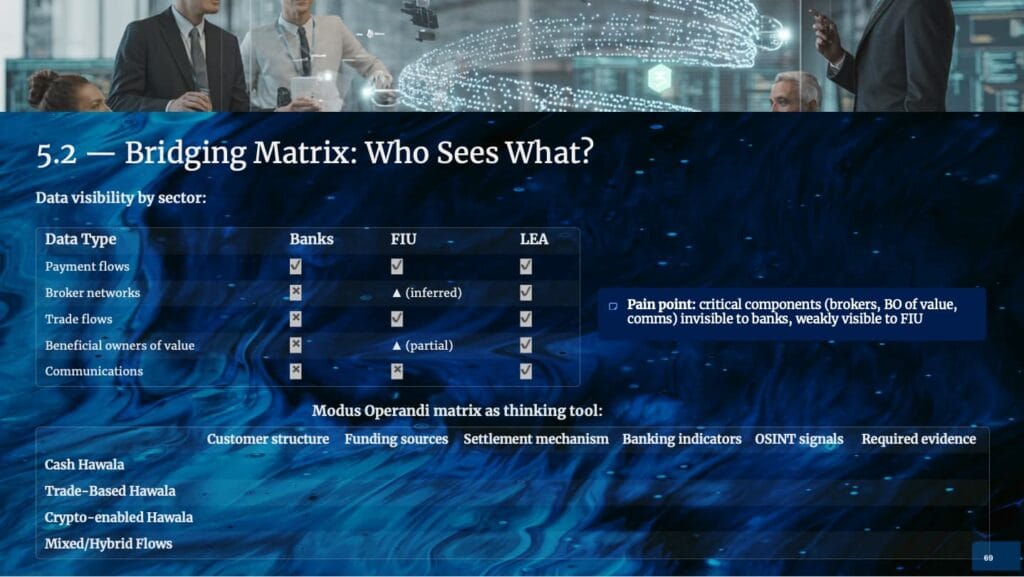
4. Bridge Matrix: who sees what?
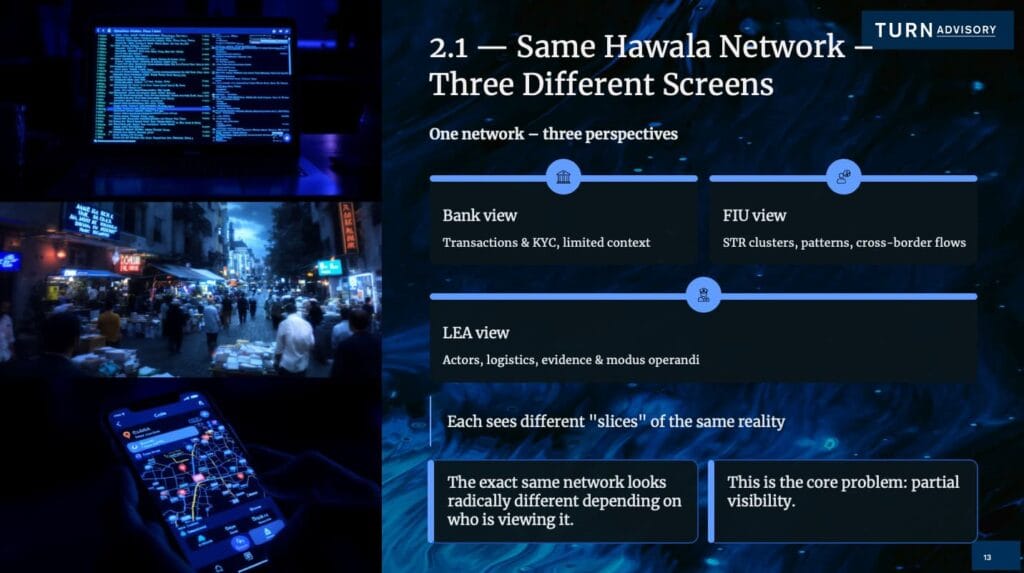
- Banks see transactions and KYC inconsistencies
- FIUs see patterns, clusters and cross-institutional links
- LEAs see actors, communications and the real value chain
No single actor can see the full picture.
The Hawala MO only becomes visible when these perspectives are stitched together.
Finally, I demonstrated how agentic AI can support LEAs by automatically extracting inconsistencies, detecting payer–buyer mismatches, linking shell networks and reconstructing MO across thousands of unstructured documents — a task that previously took us weeks.We cannot prevent what we cannot see — and we cannot see what we do not connect.